What Dog Owners Can Learn From Wolves About Leadership
A famous story about how a wolf pack travels keeps circulating online. Whatever its origins, it captures what your dog needs from you: a calm leader who keeps the group together.
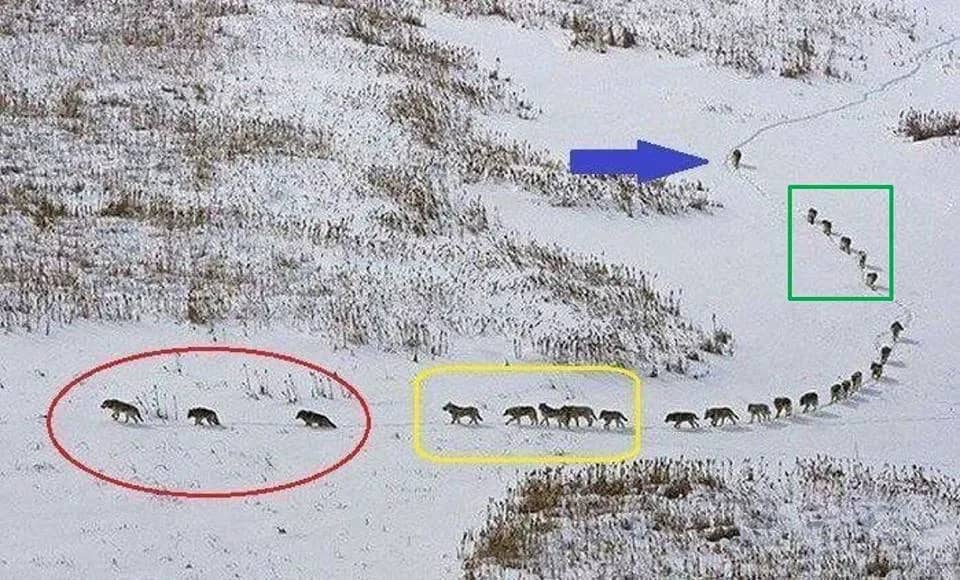
You have probably seen the picture. A long line of wolves crossing snow, and a caption explaining that the old and sick walk in front to set the pace, the strongest guard the front and the rear, and the leader walks last, watching over everyone. The story has traveled the internet for years. People who study wild wolves will tell you the photograph shows something simpler: a pack moving in single file through deep snow, with an experienced animal breaking the trail. And yet the story refuses to die, because what it describes is true in a deeper sense. It describes what good leadership feels like to the ones being led. Those are the leadership lessons from wolves we want to talk about, because they are exactly what your dog is waiting for from you.
Dogs live by the law of the pack
Your living room is not a forest, and your dog is not a wolf. But in the canine world, one law reigns above all others: the law of the pack. In a pack there is always a leader, a figure of decisiveness and calm strength whose authority is not in question, and every other member knows its place. Puppies learn these rules from their mother, who corrects them the moment they cross a line. Later, other dogs reinforce them. Dogs grasp this instinctively; it is shaped by the energy they are born with.
The trouble starts when a dog comes to live with people who do not lead. Give a dog one percent of freedom and it will take it. Give it a hundred percent, with no boundaries, and it will use every bit. A dog that senses no leader does not relax. It fills the vacancy itself, and that is where pulling, guarding, barking and bolting come from. The wolf story resonates because a pack with a real leader is a calm pack.
Five lessons from the pack
Lesson one: the leader sets the pace
In the story, the pace is set so that no one falls behind. On your walks, you set the pace. The dog walks at your left, on a loose leash, and goes where you go. When it surges ahead, you do not pull back; you change direction, and it learns that it has to watch you to know where the walk is going. A dog that chooses the route is not being spoiled. It is being left without a leader, and most dogs find that stressful.
Lesson two: the leader goes first where it matters
You go first through every door, in and out. The dog waits, then follows. The dog gets nothing to eat until it has followed at least one command, and it sits before the bowl is set down. These are small rituals, repeated every day, and they do more to tell a dog who leads than any amount of talking. Dogs do not follow commands. They follow leaders. In The Stevelic Method the leader is not the loudest or the strongest; it is the calmest and the most consistent.
Lesson three: strength is quiet
A leader in a stable pack rarely has to fight. It holds its position through steady energy and clear signals, not through constant displays of force. The same is true for you. Shouting, hitting and shock collars are what people reach for when they have lost the dog’s respect and are trying to take it back by force. Real authority is a low, calm voice, an upright, still posture, and one command, said once, then enforced. Dogs read energy long before they hear words. If your energy is unbalanced, your dog senses it and keeps its distance.
Lesson four: nobody is left behind
The most moving part of the story is the leader at the back, making sure no one is lost. That is the part of leadership owners forget. Being the leader means being responsible: for exercise, for structure, for the dog’s safety, and for the hard moments when the dog is frightened or struggling. A fearful dog needs a leader who stays steady and builds its confidence, not one who punishes it. A dominant dog needs a leader who is firm without anger. In the method we often remind owners that when a dog is in a DOWN and you walk away, you always return to it; you never call it from there. The dog has to learn that its leader comes back.
Lesson five: the pack corrects, and moves on
When a mother corrects her puppy, it is immediate, brief, and over. There is no grudge and no lecture. Correct your dog the same way: in the moment, with one firm NO, and then let it go. A dog cannot connect a correction to something it did an hour ago. Punishment after the fact teaches nothing but fear. And when the dog gets it right, say so, within two seconds, with warmth.
What to do today
Pick one ritual and keep it for a week: you go first through every door. Nothing else changes. Watch how your dog starts to pause and look at you before it moves. That pause is the beginning of everything. Then read how the whole picture fits together on The Stevelic Method page and, if you live with a strong-willed dog, our guide to training a dominant dog. A dog becomes a mirror of its owner. Give it a leader worth following.
Comments
No comments yet. Be the first.